
Almost every patient who sits down with Dr Vlad ILLIE for a neck consultation asks for the same thing: tighter skin. It is an entirely understandable request — but it is also, respectfully, the wrong question. Dr ILLIE’s approach to neck lifting is built on a different premise: a result that lasts is not built by pulling skin. It is built by rebuilding what lies beneath it.
The Myth of the "Skin-Deep" Lift
Skin has a memory. Understanding this single fact changes everything about how a lasting result is planned.
Skin is elastic by design — it stretches to accommodate movement, and it is meant to spring back. When skin alone is used to hold up sagging deeper tissue, that same elasticity works against the result. Pulled tight over structures it was never designed to support, skin will gradually creep and stretch back out, typically within 18 to 24 months. The jawline softens again, and the scars — placed under far more tension than they should be — widen and become more visible over time.
Dr Vlad ILLIE approaches a neck lift that is genuinely built to last as an exercise in structural engineering, not fabric tailoring. His goal is to reshape the framework underneath — muscle, fat, glands and, in some cases, the position of the tissue against the skeleton itself — so that the skin can simply drape over a new, well-supported contour. No pulling required.
“The skin should be the last thing we touch, and the least important thing holding the result together.”
The Platysmal "Internal Corset"
Before any contour can be sculpted, the central neck needs a stable foundation to sit on.
Running beneath the skin of the neck is the platysma — a thin, wide sheet of muscle that stretches from the collarbone up towards the jaw. In youth, it sits smooth and taut. Over time, its two halves separate along the midline and begin to sag, and this is precisely what produces the vertical “turkey neck” bands that so many patients are self-conscious about.
To correct this, Dr ILLIE works through a deeper surgical plane to reach the platysma directly and perform what is known as a midline platysmaplasty. The separated edges of muscle are brought back together and secured with sutures along the centre of the neck — creating what Dr ILLIE often describes to his patients as an internal corset, or an anatomical hammock. This repair does two important things at once: it elevates the floor of the mouth and re-establishes a firm, well-defined line along the jaw. Everything Dr ILLIE builds afterwards relies on this foundation being secure.
Subplatysmal Refinement
Fullness under the chin is rarely just surface fat — and treating it as though it is can leave a heavy, unresolved result.
Standard liposuction addresses only the fat that sits above the platysma muscle, close to the skin. It can help, but for many patients it doesn’t tell the whole story. A meaningful proportion of “double chin” fullness actually sits beneath the muscle layer, alongside structures that standard liposuction never reaches.
This is where Dr Vlad ILLIE’s deep neck technique distinguishes itself. Working beneath the platysma, Dr ILLIE meticulously removes excess subplatysmal fat, addresses the anterior digastric muscles when they are contributing to fullness, and — where relevant — reduces the size of enlarged or drooping submandibular (salivary) glands. Left untreated, an enlarged gland will continue to create a soft, bottom-heavy contour under the jaw, regardless of how tight the skin above it looks. Managing it at the time of surgery is what allows the final result to look clean and resolved, rather than “almost there.”
Why it matters long-termSkipping this deeper layer is one of the most common reasons patients feel their neck lift results are underwhelming, or that fullness seems to return — the visible skin was addressed, but the structures actually causing the fullness were left untouched.
Managing the Hyoid Bone
There is one structure that quietly sets the physical limits of every neck lift — and it has nothing to do with skin or fat.
The hyoid is a small, U-shaped bone that floats in the neck, unattached to any other bone in the body. It acts as the anchor point for the muscles of the neck and floor of the mouth, and its position determines the cervicomental angle — the angle formed where the chin meets the neck, and the single biggest factor in how “sharp” a jawline can ever appear.
A high, retracted hyoidSits further back and higher in the neck. This is the anatomical “genetic jackpot” that allows for a crisp, close-to-90-degree angle beneath the chin — the profile most patients picture when they imagine an ideal result. |
A low, anterior hyoidSits lower and further forward. This naturally produces a softer, more obtuse angle, regardless of how much weight is lost or how tight the skin above it is pulled.
|
Vertical Re-suspension
The direction a lift moves in matters just as much as how much lifting is done.
Ageing in the face and neck follows gravity — it is a vertical drop. It follows, then, that a correction which genuinely reverses that process also needs to move in a vertical direction. This is a principle Dr Vlad ILLIE builds every neck lift around: when deeper tissue is instead pulled backward, toward the ears, the result can look tight rather than youthful — a flattened, widened appearance that is often what people mean when they describe a facelift as looking “done.”
By repositioning the deep structures vertically, back toward where they naturally sat in youth, Dr ILLIE leaves the surface skin with very little work to do. It can simply be trimmed and closed without tension — which is precisely what allows incisions around the ear to heal as fine, closely camouflaged lines rather than visible, widened scars.
A Personal Anatomical Puzzle
A premium, long-lasting neck lift is never a single, standardised procedure. For Dr Vlad ILLIE, it is a highly individual piece of structural planning — one that considers each patient’s platysma, fat distribution, gland size, and the position of their own hyoid bone, then builds a tailored surgical plan around them. It is this level of detail, rather than any single technique in isolation, that separates a result which relapses within a couple of years from one that continues to look natural for a decade or more.
Frequently Asked Questions
How long does a properly performed neck lift actually last?
This depends almost entirely on how the lift was built. A skin-only lift, where sagging is corrected by pulling the skin tighter, tends to relapse within 18 to 24 months because skin has natural elastic memory and will gradually stretch back out.
A structurally built neck lift — one that repairs the platysma muscle, addresses deeper fat and glands, and works with your hyoid bone position — is a different proposition entirely. This is the approach Dr Vlad ILLIE takes with every patient, because tissue support doesn’t have the same elastic “spring-back” as skin, and these results are typically far more stable. Many of Dr ILLIE’s patients see their result hold well for a decade or more. Your own skin quality, genetics, sun exposure and weight stability will still influence the finer details, but the surgical foundation is the single biggest factor in longevity.
Am I a good candidate for a deep-plane neck lift?
Good candidates are generally in stable overall health, at a stable weight, and are noticing genuine looseness in the neck skin and muscle — banding, jowling, or a soft “double chin” that persists despite diet and exercise — rather than purely excess fat with good skin tone.
Because so much of a lasting result depends on individual anatomy — your platysma, your fat distribution, your hyoid position — Dr Vlad ILLIE assesses candidacy on a case-by-case basis. Some patients are excellent candidates for the full structural approach described in this guide; others may only need one or two elements of it, or may be better suited to a non-surgical option first. A comprehensive consultation and physical assessment with Dr ILLIE is the only reliable way to know which category you fall into.
What's the real difference between a neck lift and simple liposuction under the chin?
Liposuction alone only removes fat sitting above the platysma muscle, close to the surface of the skin. It can soften mild fullness, but it does nothing to address loose or separated muscle, fat sitting beneath the muscle layer, enlarged salivary glands, or the position of the hyoid bone — all of which contribute to the “heavy neck” appearance for many patients.
A comprehensive neck lift is a layered procedure that can include muscle repair (platysmaplasty), deep subplatysmal fat and gland reduction, hyoid-focused suspension, and vertical repositioning of tissue, with skin only trimmed at the very end. Liposuction can be one small component of this broader plan, but on its own it’s rarely enough to produce a defined, long-lasting jawline in patients with genuine skin and muscle laxity.
Do I need a full facelift too, or can the neck be treated on its own?
Not necessarily. Many patients — particularly those whose main concern is banding, fullness or jawline definition rather than mid-face or cheek sagging — are excellent candidates for an isolated neck lift, sometimes performed with a limited incision that doesn’t extend into a full facelift pattern.
That said, the neck and lower face age together, and in some patients a combined procedure produces a more harmonious, balanced result than treating the neck in isolation. Whether to combine the two comes down to your specific pattern of ageing, your goals, and Dr ILLIE’s assessment of what will give the most natural-looking outcome — this is one of the key things discussed at a deep plane consultation with Dr Vlad ILLIE.
What does recovery actually look like, and when can I get back to normal life?
Most patients experience swelling and bruising that is most noticeable in the first 7 to 10 days, along with some tightness or numbness across the neck as the tissues settle — this is normal and expected given the structural work being performed beneath the skin. A supportive garment is typically worn for a period after surgery to help the tissues heal in their new position.
Many patients feel comfortable returning to quiet, non-strenuous daily activities within 1 to 2 weeks, with more noticeable swelling largely settled by around 3 to 4 weeks. However, because deeper structures — muscle, fat and sometimes the hyoid attachment — have been worked on, final settling and the truly “finished” contour can continue to refine for several months. Dr ILLIE will give you a recovery timeline specific to exactly which techniques were used in your procedure.
Will I be left with visible scarring?
Scar visibility comes down largely to tension. As explained in this guide, when the deeper structures are repositioned vertically and provide the actual support, the overlying skin can be closed with little to no tension along the incision line — and it’s tension, more than incision placement, that causes scars to spread and thicken over time.
Incisions are typically placed to follow the natural contours around and behind the ear, and in appropriately planned, tension-free closures, they generally heal to become fine, pale lines that are well camouflaged within these natural creases and the hairline. Individual healing varies from patient to patient, and factors like skin type, sun protection and genetics also play a role.
What exactly is the hyoid bone, and why does my surgeon keep mentioning it?
The hyoid is a small, U-shaped bone that sits in the upper neck, unattached to any other bone — it effectively “floats,” anchored only by muscles and ligaments. It’s the structure that most determines your cervicomental angle: the angle formed where your chin meets your neck, and the biggest single factor in how sharp or soft a jawline can appear.
Its position is set by your own skeletal anatomy and can’t be changed. What can be managed surgically is how the surrounding soft tissue relates to it — through techniques like hyoid suspension, where the platysma muscle is secured directly to the tissue around the hyoid. This is why Dr Vlad ILLIE assesses and discusses hyoid position with every patient: it sets the realistic ceiling for how defined your result can be, and helps set expectations that are honest rather than generic.
Is a neck lift painful, and what type of anaesthesia is used?
Most patients describe the first few days after surgery as tight, pulling or uncomfortable, rather than acutely painful, and this is generally well managed with prescribed pain relief. Discomfort tends to reduce noticeably after the first week as swelling begins to settle.
Procedures of this depth and complexity are usually performed under general anaesthesia (or in some cases deep sedation with local anaesthetic), with a specialist anaesthetist present throughout to monitor your comfort and safety. The specific approach will be tailored to the extent of your procedure and discussed with you in detail before your surgery date.
What are the risks and possible complications I should know about?
As with any surgical procedure, a neck lift carries general risks such as bleeding, infection, anaesthetic risk, and changes in skin sensation, as well as procedure-specific considerations such as asymmetry, irregularities in contour, or (rarely) temporary changes to nerve function affecting movement or sensation in the area.
Because deeper techniques such as gland reduction and hyoid suspension involve working close to important nerves and structures in the neck, they should only be performed by a surgeon with specific experience in deep neck anatomy — an area Dr Vlad ILLIE has dedicated particular focus to throughout his career. Revision surgery is occasionally needed, and this, along with your individual risk profile, will be discussed thoroughly and honestly during your consultation — Dr ILLIE will never minimise these conversations.
If my neck relaxes again years later, does that mean the surgery has failed?
Not at all — it usually means one thing: you’re still ageing, which is entirely normal. No surgical procedure stops the clock permanently. What a well-built, structural neck lift does is reset the clock significantly and slow the rate of visible relapse, because the support comes from muscle and tissue repositioning rather than skin tension alone.
Most patients who have had a structurally sound neck lift find that if any softening does occur many years down the track, it is far more gradual and far less pronounced than their original concern — and often only a smaller, more minor refinement is needed, rather than starting again from scratch.
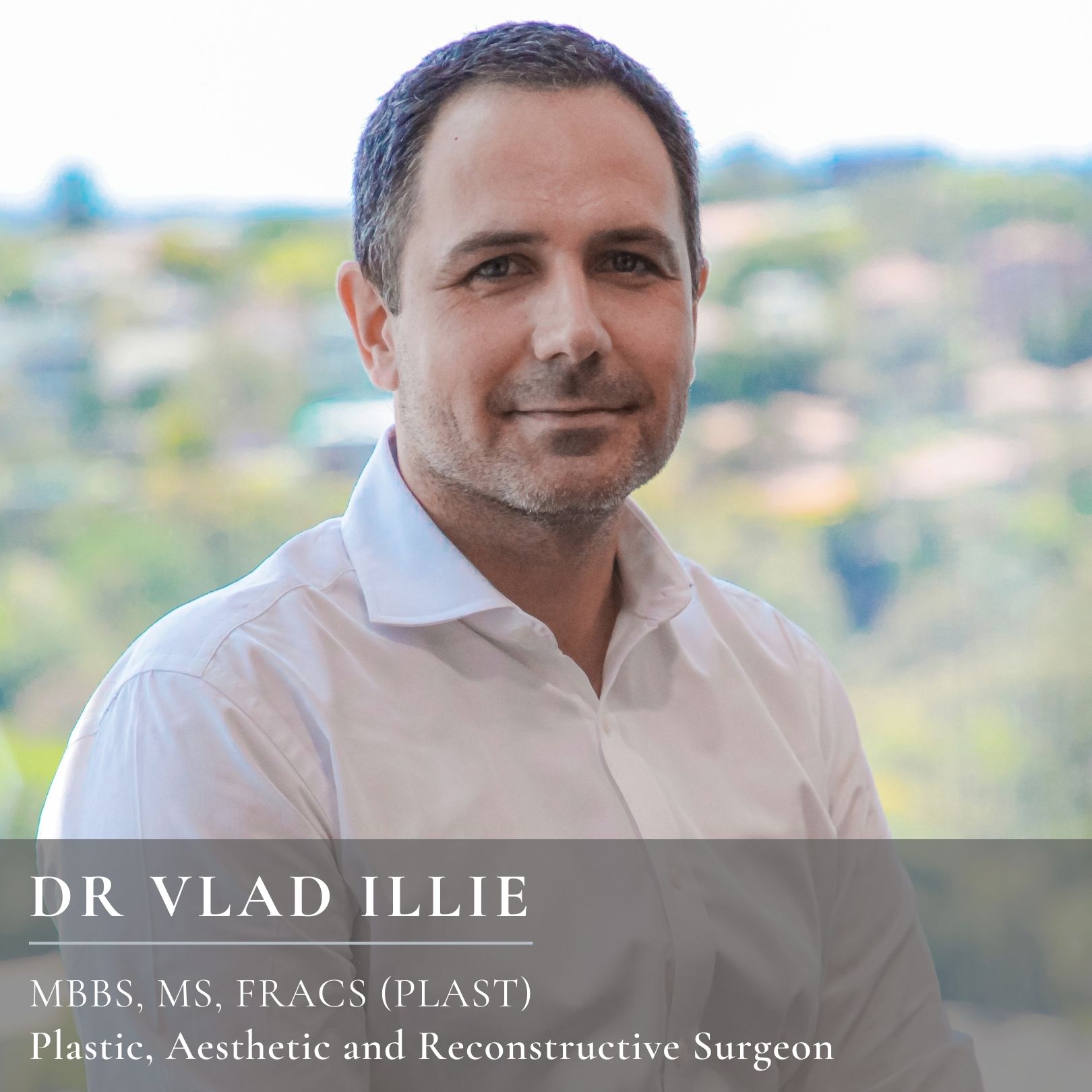
Dr Vlad ILLIE
MBBS, MS, FRACS (plastic and reconstructive surgery)
AHPRA Registration Number MED0000966953
Dr Vlad ILLIE is a Sydney-based specialist plastic and reconstructive surgeon known for his meticulous surgical technique, patient‑centred philosophy, and commitment to natural, long‑term outcomes. With extensive experience across aesthetic and reconstructive surgery, he combines rigorous, research-led practice with a calm, thoughtful approach that supports patients through every stage of their surgical journey.
In addition to his operative work, patients can access a carefully chosen range of evidence-based non‑surgical treatments in his clinic, ensuring a cohesive and thoughtful pathway of care.
Understand your own anatomy, in detail
Every neck is built differently — including yours. In a comprehensive deep plane consultation, Dr Vlad ILLIE will assess your platysma, deep fat compartments and hyoid bone position, and talk you through what a lasting result would realistically look like for your unique anatomy.
Read This Next
Why Does the Neck Age First? The Real Reason It Sags Before the Face
It's one of the most common observations patients bring to consultation: “My face still looks like me, but my neck looks so much older.” It's not your imagination, and it's not a sign that anything has gone wrong. There's a real, anatomical reason the neck tends to...
Lower Eyelid Surgery: What I Check For, and How Complications Are Avoided
Lower eyelid surgery has a reputation — and it's not entirely undeserved. Done without a thorough assessment beforehand, it's one of the procedures most likely to produce a visibly ‘operated on’ result: an eye that looks pulled down, rounded, or shows too much white...
Heavy Upper Eyelids: Why They Can Leave You Looking (and Feeling) Tired
“Am I just tired, or is it my eyelids?” It's a question I hear constantly, and often the honest answer is both — heavy, hooded upper eyelids can genuinely make you look more tired than you feel, and in a lot of cases, make you feel more tired than you should, too....
Plastic Surgery Articles – Dr Vlad ILLIE in Sydney
Explore clear, clinically grounded guidance on contemporary plastic surgery and cosmetic medicine. Each piece offers practical information to help you understand modern techniques, treatment considerations, and the principles that shape contemporary aesthetic...
Breast Augmentation Surgery in Sydney
Breast augmentation (augmentation mammoplasty) is a surgical procedure that involves placing implants to increase breast size or improve breast shape. It addresses concerns such as changes in breast volume that may occur after pregnancy, weight fluctuations, or...
Arm Lift Surgery in Sydney
An arm lift (brachioplasty) is a surgical procedure that addresses changes in the upper arm appearance that can occur after significant weight loss, ageing, or other factors, such as loose skin, excess fat deposits, and reduced arm contour definition. The...