
Every surgical procedure leaves a scar. There’s no way around that — it’s simply how skin closes and heals. But there’s a big difference between a scar that’s left to do its own thing and one that’s actively supported through the healing process, and patients often ask me what actually makes that difference.
The honest answer is that most scars improve a great deal on their own over the first year. But the choices you make in the weeks around surgery — what you put on the scar, how you protect it, even what you eat — genuinely do influence how it settles. This article covers what I recommend to my own patients, and why, in more detail than you’ll usually get in a post-op handout.
The healing timeline
How a Scar Actually Heals
A scar at six weeks is not the scar you’ll have at twelve months — the slowest, most important phase of healing is still ahead.
A healing scar goes through a few overlapping stages. In the first couple of weeks, the wound is focused on closing and protecting itself — this is when a scar looks red, raised and sometimes a little angry. Over the following months, the body lays down new collagen to strengthen the area, which is why a scar often looks its worst somewhere between six and twelve weeks before it starts to visibly improve.
The final stage — remodelling — is the slow part. Scars continue to soften, flatten and fade for up to 12 to 18 months after surgery. This is genuinely useful to know, because it means judging a scar’s final appearance at the six-week mark is judging it far too early.
The Inflammatory Phase (First 1–2 Weeks)
The wound is focused on closing and protecting itself. This is when a scar looks red, raised and sometimes a little angry — that’s normal, expected biology, not a sign of a problem.
The Proliferative Phase (Weeks 2–12)
The body begins laying down new collagen to rebuild strength in the wound. New blood vessels form to support this rebuilding, which is part of why a scar often looks quite pink or red during this stage. This is also, somewhat counterintuitively, when a scar frequently looks its worst — often somewhere between six and twelve weeks — precisely because so much active rebuilding is happening just beneath the surface. Patients are often alarmed at this stage, worried the scar is ‘getting worse,’ when in fact it’s simply mid-repair.
This is also the window where the choices covered later in this article — silicone therapy, sun protection, gentle massage once cleared — have the most influence, because the collagen being laid down now is what determines the scar’s eventual thickness and texture.
The Remodelling Phase (3–18 Months)
This is the slow part. The collagen fibres that were laid down somewhat haphazardly during the proliferative phase gradually reorganise into a more orderly, flatter structure. Blood vessel density in the scar reduces, which is why colour fades from pink or red toward a paler tone closer to your surrounding skin. Scars continue to soften, flatten and fade for up to 12 to 18 months after surgery — genuinely useful to know, because it means judging a scar’s final appearance at six weeks is judging it far too early. I ask patients to hold off on final judgement until at least the six-month mark, and ideally closer to twelve.
Why Some Scars Heal Better Than Others
Genetics play a real role — some people are simply more prone to thicker, raised, or discoloured scarring (including keloid or hypertrophic scarring), regardless of how well the wound is cared for. Wound tension matters too: a scar under more mechanical tension, such as one crossing a joint or a naturally mobile area, tends to widen and thicken more than one in a low-tension area. Wound depth, infection during healing, and even the direction a scar runs relative to natural skin tension lines all play a measurable role in the final result.
What we recommend
What Helps a Scar Heal Well
Here’s what I recommend, and when.
Silicone Therapy
Silicone sheets or gels are one of the most well-supported options for improving how a scar looks and feels once the wound has closed. We use products from Nokori in our practice, applied consistently once the incision has fully sealed, typically for eight to twelve weeks or as advised.
How Silicone Therapy Works, and How We Use It
Silicone works by hydrating the outer layer of the healing scar and creating a stable, protective barrier over it, which appears to help regulate the collagen production happening underneath and reduce excess blood vessel formation — both of which contribute to a flatter, paler, softer scar over time. We use products from Nokori in our practice. Application generally begins once the incision has fully sealed (no open skin, no scabbing), typically starting from around two weeks post-surgery and continuing consistently for eight to twelve weeks, sometimes longer for scars that are healing with more thickness or tension. Consistency matters more than any single application — silicone needs many hours of daily skin contact to have a meaningful effect, so sporadic use tends to produce disappointing results regardless of the product used.
Managing Bruising
Bruising around a healing incision is a normal part of the body’s response to surgery, caused by small blood vessels leaking under the skin. It typically resolves over one to three weeks, moving through a fairly predictable colour change from deep purple-blue to green, yellow, and finally fading entirely.
We often recommend Alastin’s InHance serum during this window, which some patients find supports the skin’s appearance while bruising resolves. As with any topical product, individual response varies, and it works best as part of a broader recovery routine rather than in isolation.
Supplements Before and After Surgery
Bromelain (an enzyme derived from pineapple stems) and quercetin (a plant-derived antioxidant) are sometimes recommended around the time of surgery. Some patients find they support the body’s natural response to bruising and swelling in the days following a procedure. If we recommend these for you, we’ll give you specific timing — including when to stop before surgery, since some supplements can increase bleeding risk and need to be ceased in advance, typically at least a week or two before your procedure depending on the supplement and the surgery involved. Always check with us, or your GP, before starting any supplement around the time of a procedure, particularly if you take blood-thinning medication or have a bleeding disorder.
Sun Protection
A healing scar is far more likely to darken permanently — a process called post-inflammatory hyperpigmentation — if it’s exposed to the sun during its first year, since new scar tissue produces melanin far more reactively than mature skin. Keeping it covered with clothing, or well protected with a broad-spectrum SPF 50+ sunscreen once the skin has closed, is one of the simplest, most effective things you can do, and it’s one of the most commonly overlooked.
Scar Massage
Once a wound has properly closed — usually a few weeks in, and only once your surgeon has confirmed it’s ready — gentle, firm massage in small circular motions may help soften the scar, break up excess collagen bundling, and improve its overall texture and mobility, particularly for scars that feel tight or ‘stuck’ to the tissue beneath. We’ll show you the specific technique, direction and pressure to use at your follow-up visit, since this varies depending on where the scar is and how it’s healing.
When a Scar Needs Extra Help
Occasionally a scar heals with more tension, thickness or discolouration than expected, despite good aftercare. In these cases, further options include steroid injections to soften and flatten a raised or thickened scar, laser treatment to address persistent redness or textural irregularity, or, less commonly, surgical revision for scars that have healed with significant tension or an unfavourable position. This is something we’d discuss at a follow-up if your scar isn’t progressing the way we’d expect for its stage of healing.
Supporting recovery
Everyday Tips for Better Healing
- Eat well — protein and a generally nutrient-rich diet support tissue repair at a cellular level.
- Stay well hydrated, particularly in the first few weeks after surgery.
- Avoid smoking, which is well known to slow healing and worsen scarring by reducing blood flow to the skin.
- Keep moving gently, as good circulation supports healing, but follow your surgeon’s specific activity guidance for your procedure.
- Be patient — a scar at 8 weeks is not the scar you’ll have at 12 months, and the most dramatic improvement often happens after the point most patients stop paying close attention.
Frequently Asked Questions
When should I start using silicone on my scar?
Once the wound has fully closed and there’s no open skin or scabbing — typically from around two weeks after surgery, though we’ll confirm the exact timing at your follow-up appointment since this varies by procedure and how quickly you heal. Starting too early, before the skin has properly sealed, can irritate the wound rather than help it, so it’s worth waiting for the specific green light rather than guessing.
How long will it take for my scar to fade?
Most scars continue improving for 12 to 18 months after surgery, moving through distinct healing phases. The scar you see at six or eight weeks — often at its most red and raised — is very rarely the final result. The most significant softening and fading typically happens in the second half of that first year, well after most patients have stopped paying close attention.
Is it safe to take bromelain and quercetin before surgery?
Only under guidance. Some supplements affect bleeding and platelet function, and need to be stopped a specific number of days before surgery — often one to two weeks, depending on the supplement and the procedure. Always check exact timing with us or your GP first, particularly if you’re also taking prescribed blood-thinning medication.
Why does my scar look worse at six weeks than it did at two?
This is a completely normal part of healing, not a sign of a problem. Scars often look their most obvious somewhere between six and twelve weeks, during the proliferative phase when the body is actively laying down new collagen and blood vessels. It genuinely does get better from here as the scar moves into its longer remodelling phase.
Can I use any silicone product, or does the brand matter?
Consistency of daily use matters more than any single brand — silicone needs many hours of skin contact each day to have a meaningful effect. We recommend Nokori’s products in our practice and can talk you through correct application and wear time for your specific scar.
What can I do about a scar that’s already old?
Older, established scars can still respond to treatment. Options include laser therapy for persistent redness or texture, steroid injections for raised or thickened scars, and in some cases surgical revision for scars that healed with significant tension or an unfavourable position. It’s worth an assessment rather than assuming nothing more can be done.
Does diet actually make a difference to healing?
Yes, to a meaningful degree. Adequate protein intake supports your body’s collagen-building processes during healing, and general hydration and nutrition affect how efficiently your body can repair tissue. It’s not the only factor, but it’s one of the more controllable ones.
Is it normal for a scar to feel itchy or tight while healing?
Very normal, particularly during the collagen-building phase in the first few months, as new tissue forms and nerve endings regenerate. Gentle massage, once your wound is fully closed and your surgeon has cleared you to start, may help with both the itching and the tightness.
Should I avoid the sun on my scar even once it’s healed?
Sun protection matters most in the first 12 months, when a scar is significantly more likely to darken permanently if exposed, since new scar tissue produces melanin more reactively than mature skin. Ongoing protection afterward is still sensible, though the risk of permanent discolouration reduces considerably once a scar has fully matured.
Can smoking really affect how my scar heals?
Yes, significantly. Smoking reduces blood flow and oxygen delivery to healing tissue, which is well documented to slow wound healing and worsen scarring — including increasing the risk of wound breakdown in more significant procedures. This is why we discuss smoking directly with patients well ahead of surgery, not just as an aside.
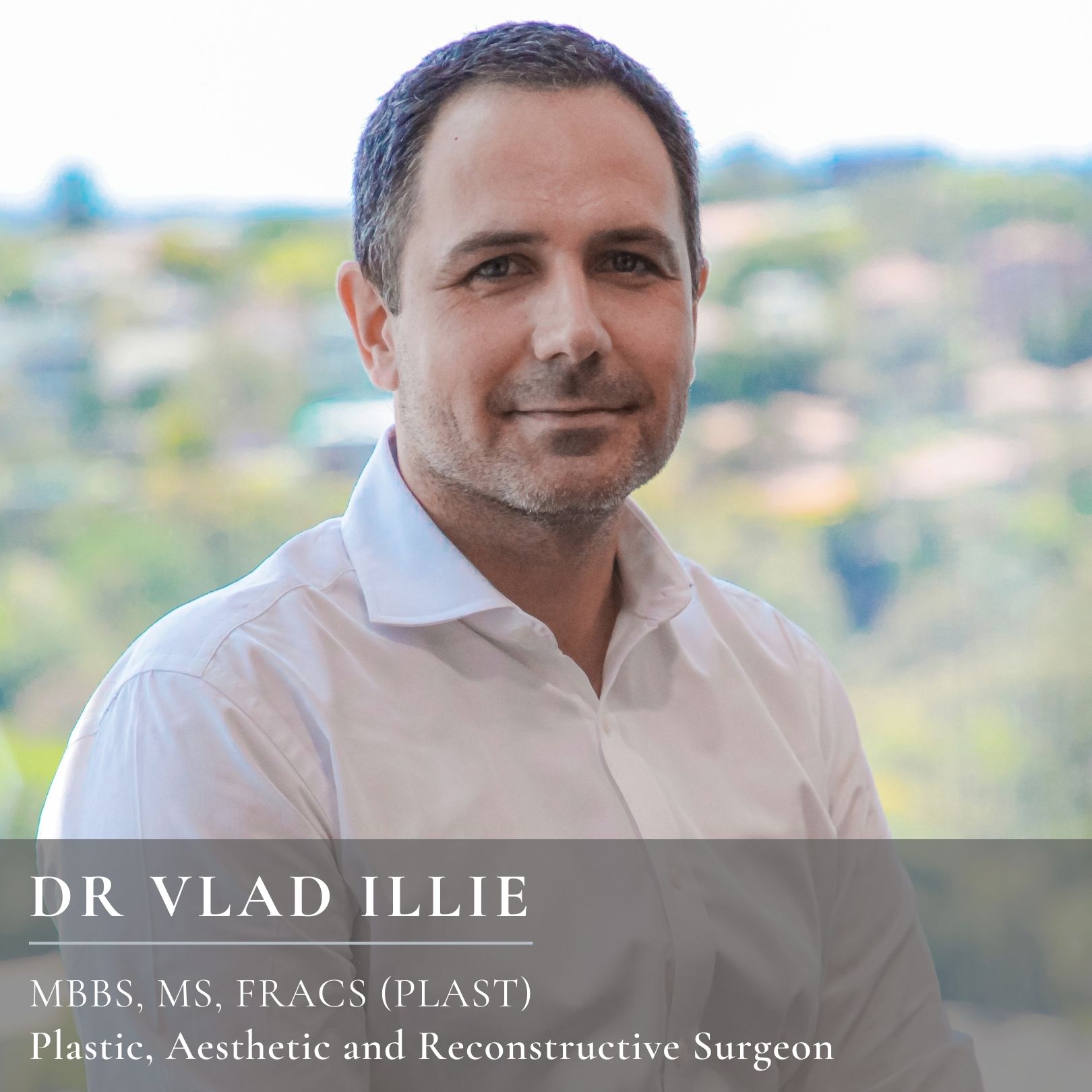
Dr Vlad ILLIE
Specialist Plastic and Reconstructive Surgeon
MBBS, MS, FRACS (plastic and reconstructive surgery)
AHPRA Registration Number MED0000966953
Dr Vlad ILLIE is a Sydney-based specialist plastic and reconstructive surgeon known for his meticulous surgical technique, patient‑centred philosophy, and commitment to natural, long‑term outcomes. With extensive experience across aesthetic and reconstructive surgery, he combines rigorous, research-led practice with a calm, thoughtful approach that supports patients through every stage of their surgical journey.
In addition to his operative work, patients can access a carefully chosen range of evidence-based non‑surgical treatments in his clinic, ensuring a cohesive and thoughtful pathway of care.
Ready to explore your options?
If you’re considering a procedure or simply want clarity on what suits you, starting with a conversation is the most helpful step. Our team offers thoughtful, personalised guidance to help you understand your options and your timing.
Read This Next
Sagging Mouth Corners: Why It Happens and What Can Help
“I don't feel sad or angry, but people keep asking if I'm okay.” I hear a version of this often, usually from patients noticing that the corners of their mouth have started to turn downward, giving their resting expression a look they don't feel on the inside. It's an...
Your Guide to In-Clinic Skin Rejuvenation Treatments
If you've ever searched "best anti-aging treatment" online, you'll know how confusing it gets. One week it's a new device, the next it's a serum promising to "erase" wrinkles overnight. As a specialist plastic and reconstructive surgeon, I sit down with patients every...
Understanding Pigmentation: The 5 Skin Concerns I See Most Often in Clinic
Sun spots, melasma, dark marks after acne, freckles, dark circles — they can look similar on the surface but come from very different places. Here's how I tell them apart, and what genuinely helps.Pigmentation is, by a wide margin, the concern I'm asked about most in...
Plastic Surgery Articles – Dr Vlad ILLIE in Sydney
Explore clear, clinically grounded guidance on contemporary plastic surgery and cosmetic medicine. Each piece offers practical information to help you understand modern techniques, treatment considerations, and the principles that shape contemporary aesthetic...
Breast Augmentation Surgery in Sydney
Breast augmentation (augmentation mammoplasty) is a surgical procedure that involves placing implants to increase breast size or improve breast shape. It addresses concerns such as changes in breast volume that may occur after pregnancy, weight fluctuations, or...
Arm Lift Surgery in Sydney
An arm lift (brachioplasty) is a surgical procedure that addresses changes in the upper arm appearance that can occur after significant weight loss, ageing, or other factors, such as loose skin, excess fat deposits, and reduced arm contour definition. The...
Schedule a Consultation
Ph (02) 9101 4707
Fax (02) 9182 0092
office@drvladillie.com.au
Sydney Centre for Plastic Surgery
Suite 1702, Westfield Tower 2
101 Grafton St
Bondi Junction NSW 2022
Central Coast Aesthetics
Suite 2, Albany St North
Gosford NSW 2250
Breast reduction Sydney, Breast Reduction Surgery Sydney, Boob reduction, Breast Surgery, Breast reduction surgery, Breast surgery for back pain, Surgery for large breasts, Oversized breast surgery – Dr Vlad ILLIE, plastic surgeon Sydney
Breast Augmentation Sydney, Breast Surgery Sydney, Boob job Sydney, Breast Implants Sydney Eastern Suburbs, Breast Enlargement Sydney, Breast Enhancement, Breast Enhancement Sydney, Breast implant surgeon Sydney, Silicone Implants, Motiva Implants – Dr Vlad ILLIE, plastic surgeon Sydney
Breast Reconstruction Surgery Sydney, Breast Cancer Reconstruction Sydney, Diep Flap Surgery, Reconstructive Surgery, Breast Reconstructive Surgery, Breast Surgery Post-Breast Cancer, Breast Surgery Post-Mastectomy – Dr Vlad ILLIE, plastic surgeon St Vincent’s Hospital Sydney
Mummy Makeover, Saggy Breasts Surgery, Breast Lift & Implant, Boob lift, Breast enlargement and lift, Breast enhancement Sydney, Breast surgery post-pregnancy, Breast surgery post-weight loss – Dr Vlad ILLIE, plastic surgeon St Vincent’s Hospital Sydney
Breast Augmentation Sydney, Breast Surgery Sydney, Boob job Sydney, Breast Implants Sydney Eastern Suburbs, Breast Enlargement Sydney, Breast Enhancement, Breast Enhancement Sydney, Breast implant Surgeon Sydney, Silicone Implants, Motiva Implants – Dr Vlad ILLIE, plastic surgeon
Breast Revision, Breast Surgery Sydney, Breast implant revision, Breast augmentation revision, Breast implant replacement, Breast Implant Reduction, Breast Implant Replacement, Surgery for botched breasts – Dr Vlad ILLIE, plastic surgeon
Tuberous breast surgery Sydney, tuberous breast correction Sydney, tuberous breasts, plastic surgeon Sydney, cosmetic surgeon Sydney, severe tuberous breasts, mild tuberous breast, Tuberomastoplasty, Lollypop Breast Lift – Dr Vlad ILLIE, plastic surgeon Sydney
Asian Breast Surgery Sydney, Asian breast implants, Asian scar healing breast implants, Asian breast reduction Sydney, Asian breast revision Sydney – Dr Vlad ILLIE, plastic surgeon Bondi Junction
Breast implant removal Sydney, Breast explant Sydney, breast implant removal surgery, breast implant removal plastic surgeon Sydney, BREAST IMPLANT EXPLANTATION SURGERY, removal of the breast implants, breast implant revision procedures performed, including removal of breast implants – Dr Vlad ILLIE, plastic surgeon Sydney